7 Signs of Nervous System Dysregulation
And how to Know if You're Stuck in Survival Mode

Have You Ever Felt Like You're Doing Everything Right — But Still Feel Overwhelmed?
For years, I thought I simply needed better boundaries, better routines, or more discipline.
I tried therapy, personal development, meditation, journaling, and countless productivity systems. Yet no matter how much effort I put into feeling better, I still found myself exhausted, overwhelmed, and constantly running on empty. People told me I needed to slow down. And I thought I needed to try harder.
What I didn't understand at the time was that I was experiencing signs of nervous system dysregulation. Learning how the nervous system works completely changed the way I understand stress, anxiety, resilience, and personal growth. It gave me a framework for understanding why I felt the way I did and, more importantly, what actually helped.
If you've ever wondered why you can't fully relax, why you always feel "on," or whether your nervous system might be stuck in survival mode, this article will help you understand the most common signs of nervous system dysregulation and what you can do to support your recovery.
What Is Nervous System Dysregulation?
Nervous system dysregulation occurs when the nervous system has difficulty returning to balance after stress. Instead of moving flexibly between activation, rest, connection, and recovery, the body becomes stuck in protective survival responses. This can lead to symptoms such as anxiety, overwhelm, chronic stress, fatigue, difficulty relaxing, emotional reactivity, sleep disturbances, or feeling disconnected from yourself and others. While these responses are designed to protect us, they can become problematic when they remain active long after a stressful event has passed.
Your nervous system is constantly gathering information from both your internal and external world. It scans for signs of safety, connection, uncertainty, and danger — often long before your conscious mind becomes aware of them. When your nervous system feels safe, you can think clearly, rest deeply, connect with others, and respond flexibly to life's challenges.
When it perceives threat, it shifts into survival mode. It's a brilliant biological design that has helped humans survive for thousands of years. But it becomes challanging if your system never fully returns to a state of safety. This can have different reasons, but first, let’s dive into the main responses of your nervous system.
The Four Main Survival Responses
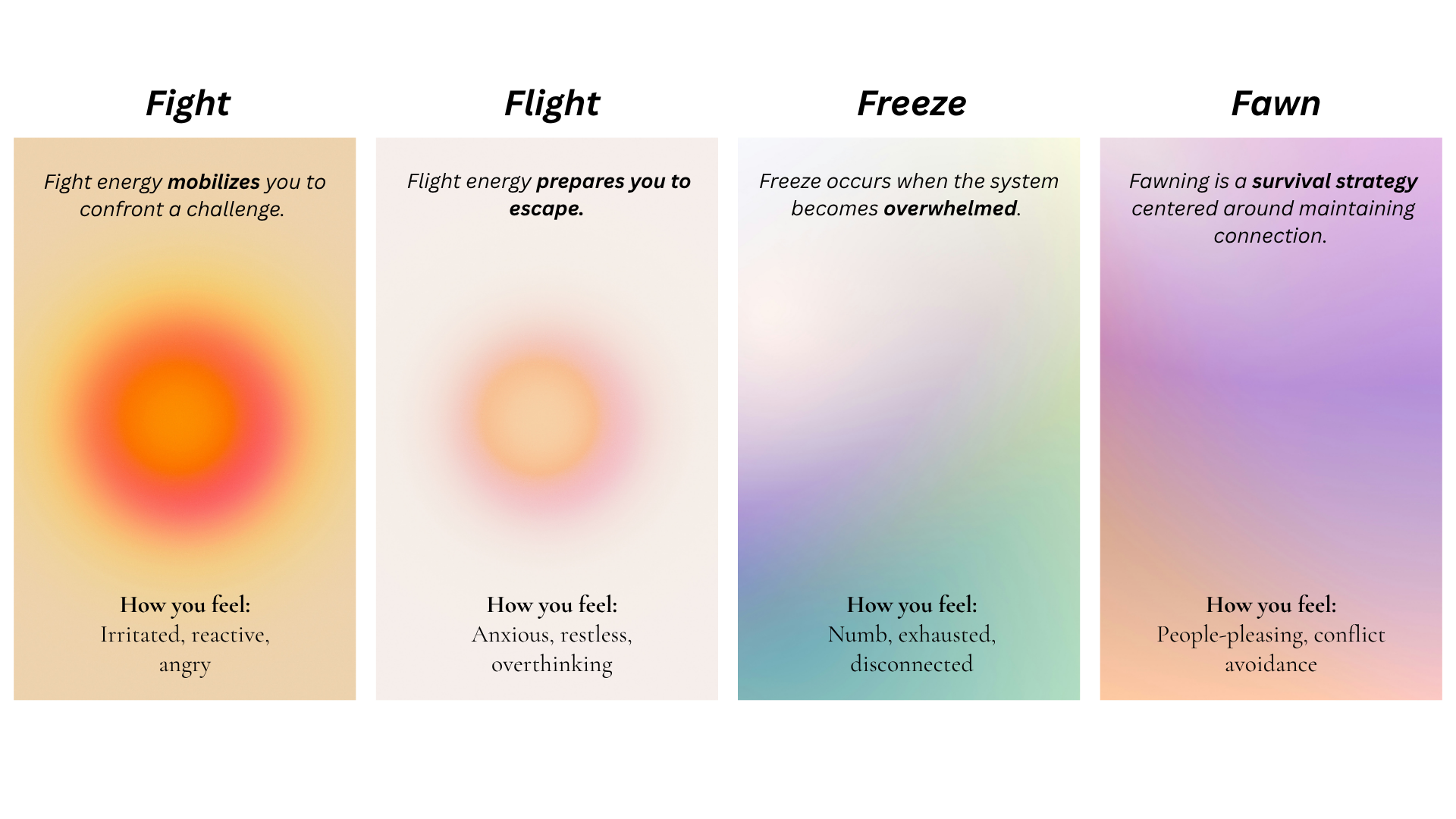
Fight → Fight energy mobilizes you to confront a challenge. You may feel irritable, frustrated, controlling, impatient, or easily angered.
Flight → Flight energy prepares you to escape. It often shows up as anxiety, overthinking, perfectionism, busyness, or the feeling that you always need to keep moving.
Freeze → Freeze occurs when the system becomes overwhelmed. You may feel numb, exhausted, disconnected, stuck, or unable to take action.
Fawn → Fawning is a survival strategy centered around maintaining connection. You may prioritize other people's needs, avoid conflict, and struggle to express your own boundaries.
This for responses are brilliant, the only problem begins, begins when your nervous system no longer knows how to return “home”. If you stay in either of this survival responses, well you might guess it - you are trying to survive. Instead of thrive.
Imagine Your Nervous System as a Map
Think of your nervous system as a landscape. There is a place that feels like home — maybe it's a peaceful meadow, a quiet beach, or a sunlit forest path. Whatever makes you go like “ahh, I can relax here” This is your regulated state. Here you feel grounded, connected, curious, and open. You can rest, recover, create, and engage with life. And no joke, you are more creative and more open to explore life here than in any other state!
Then there are the more challenging regions of the map. One is a steep mountain climb where you constantly need to stay alert. There is no time to pause. No moment to fully exhale. This is the territory of fight and flight.
The other feels like a cold, empty swamp. Everything seems distant and heavy. You want to withdraw rather than engage. This is the territory of freeze.
The goal isn't to avoid these places entirely. The goal is to know how to find your way back home!
7 Signs of Nervous System Dysregulation
1. You Feel Tired but Can't Relax
This is one of the most common signs of nervous system dysregulation.
You finally finish work, sit down on the couch, and tell yourself it's time to rest. Yet somehow, rest never really arrives. Your body feels exhausted, but your mind keeps moving. You replay conversations, think about tomorrow's to-do list, or find yourself scrolling on your phone without even noticing. Many people assume they have a relaxation problem. Often, they actually have a nervous system problem.
When your system has spent a long time in survival mode, slowing down can feel unfamiliar. In some cases, it may even feel uncomfortable. Your body has become accustomed to being alert, productive, and prepared for what's next. The result is a strange combination of exhaustion and restlessness. You're tired, but you can't fully switch off.
2. Your Mind Never Stops Running
Do you constantly feel like you're thinking about something? Perhaps you're planning ahead, solving problems, analyzing conversations, or worrying about things that haven't happened yet. When the nervous system perceives danger, one of its jobs is to anticipate potential threats.
For many people, this shows up as overthinking. Your mind keeps scanning for what could go wrong, what needs attention, and what you might have forgotten. From the outside, this can look like being highly organized or responsible. Internally, however, it often feels exhausting.
Even during moments that should feel enjoyable, part of your attention remains focused on managing, planning, or preparing. It's difficult to be fully present when your nervous system believes it always needs to stay one step ahead.
3. You Always Feel Like You're Behind
No matter how much you accomplish, it never feels like enough. You finish one task and immediately move on to the next. You reach a goal and quickly raise the bar again. There is always another thing to do, fix, improve, or achieve.
This persistent sense of urgency is often linked to the flight response. When your nervous system is stuck in activation, it creates the feeling that you must keep moving. Pause feels dangerous. Rest feels undeserved. And satisfaction remains just out of reach.
Many high-achieving people unknowingly live in this state for years. They become incredibly productive, yet rarely experience a genuine sense of completion.
4. Rest Feels Unproductive
You know you need a break. You know you're tired. But every time you try to rest, something feels off. Maybe you feel guilty. Maybe you become restless. Maybe you suddenly remember ten things you should be doing instead. For a nervous system that has learned to equate productivity with safety, rest can feel surprisingly uncomfortable. Busyness becomes a coping strategy.
As long as you're doing something, you don't have to slow down enough to notice what's happening underneath. This is why many people find themselves cleaning the kitchen, answering emails, or checking social media when they originally intended to relax. The body doesn't yet know how to settle.
5. Small Things Feel Overwhelming
An unexpected email. A change of plans. A difficult conversation. A delayed train. Things that objectively seem manageable suddenly feel much bigger than they should. This doesn't mean you're weak or incapable. It often means your nervous system is already operating near its capacity.
Imagine carrying a backpack filled with heavy stones. One additional stone might not seem significant, but when you're already overloaded, even a small addition can feel like too much. When the nervous system remains activated for long periods of time, your tolerance for stress decreases. Situations that once felt manageable begin to feel overwhelming.
6. You Feel Numb or Disconnected
Not everyone experiences nervous system dysregulation as anxiety. Sometimes it looks like the exact opposite. Instead of feeling too much, you feel very little. You may struggle to access joy, motivation, excitement, or connection. Life feels distant. You go through the motions, but it's as though part of you isn't fully there. This is often associated with the freeze response.
When the nervous system becomes overwhelmed and cannot fight or flee, it may conserve energy by shutting down. Many people mistake this state for laziness or a lack of motivation. In reality, it can be a protective response. Your system isn't failing. It's trying to protect you in the best way it knows how.
7. You Constantly Prioritize Everyone Else
You automatically focus on what other people need. You say yes when you want to say no. You avoid conflicts. You find it difficult to express your own preferences, boundaries, or needs. From the outside, this may look like kindness. And sometimes it is. But when people-pleasing becomes automatic, it can also be a sign of a nervous system that has learned that connection equals safety. This response is often referred to as fawning.
Rather than fighting, fleeing, or freezing, the nervous system attempts to stay safe by maintaining harmony. The challenge is that over time, you can lose touch with your own needs. You become highly attuned to everyone else while feeling increasingly disconnected from yourself. The goal isn't to stop caring about others. The goal is to create enough inner safety that your own needs can belong in the room too.
Why So Many People Get Stuck in Survival Mode
During my breathwork facilitator training, I had a realization that genuinely surprised me. I had never experienced deep relaxation. At least not in the way I understand it today. At first, that realization felt almost absurd. After all, I had spent years working on myself. I had done therapy, explored personal development, practiced meditation, reflected endlessly, and read countless books. And yet, overwhelm still felt familiar.
Looking back, I realized that being stressed had become my normal. I simply didn't know there was another way to feel. And that's the tricky part about nervous system dysregulation:
We can't recognize states we've never experienced.
If you've spent years operating with a constantly activated nervous system, that state becomes your baseline. It's like living in one small corner of a map and assuming that's the entire world. You don't know there are forests beyond the mountains because you've never been there. Only when you begin exploring new territory do you realize how much more is available. I still remember one of the first moments I experienced a deeply regulated state through breathwork. Nothing dramatic happened. There was no breakthrough. No fireworks. Instead, I suddenly noticed how much tension I had been carrying in my body without realizing it. My shoulders dropped, my breathing changed. And for a brief moment, there was simply space.
Space between thoughts.
Space between reactions.
Space to just be.
That experience taught me something important: Many of us aren't stuck because we're doing something wrong. We're stuck because our nervous system has learned to survive, but hasn't yet learned how to feel safe.
What Helped Me Shift Out of Survival Mode
One of the most fascinating things about the nervous system is that breathing sits at the intersection of conscious and automatic processes. Most functions in the body happen without us thinking about them. Breathing is different. It happens automatically, but we can also influence it consciously. That makes it one of the most accessible tools we have for supporting nervous system regulation. But breathwork wasn't the only thing that helped me. What created lasting change was a combination of understanding, awareness, and consistent practice.
1. Nervous System Education
Learning how the nervous system works changed everything. Instead of seeing myself as broken, lazy, too sensitive, or incapable, I began understanding my experiences through a different lens. I wasn't failing. My body was adapting. That shift alone created a surprising amount of self-compassion. Because it's difficult to work with something you don't understand. And it's even harder to change something you're constantly judging.
2. Breathwork
Breathwork gave me a direct way to communicate with my nervous system. Not by forcing relaxation. Not by trying to control my emotions. But by creating conditions that supported safety, presence, and regulation. Over time, I learned to notice how different breathing patterns influenced my energy, focus, and emotional state. The goal wasn't to feel calm all the time. The goal was to become more flexible. More resilient. More capable of returning to balance.
3. Somatic Awareness
For years, I lived mostly in my head. I could analyze my experiences endlessly. But I wasn't very connected to what was happening in my body. Somatic awareness helped me develop a different relationship with myself. Instead of immediately reacting, fixing, or pushing through, I learned to notice.
How am I breathing right now?
Where am I holding tension?
What sensations are present?
What do I actually need?
These simple questions became powerful tools for self-awareness.
4. Consistent Regulation Practices
The practices that changed me most weren't necessarily the dramatic ones. They were the small things I repeated consistently. A few conscious breaths before opening my laptop. A short walk outside. A moment to pause between meetings. Checking in with my body throughout the day. Tiny practices. Big permission. Over time, those small moments began creating a different baseline. One that felt calmer, steadier, and more connected.
3 Simple Ways to Support Your Nervous System Today
The good news is that nervous system regulation isn't something reserved for experts. It's a skill.And like any skill, it can be learned. You don't need to change your entire life overnight. You can start with one small practice.
1. Slow Belly Breathing
Place one hand on your chest and one hand on your belly. Take a slow breath in through your nose. Notice which hand moves first. Without forcing anything, invite the breath slightly deeper into your lower ribs and belly. Imagine your breath expanding like a balloon in all directions. The goal isn't to breathe more. The goal is to become curious about how you breathe. Practice for one to three minutes.
Why it helps: Slow diaphragmatic breathing can support the parasympathetic nervous system and create conditions that encourage rest and recovery.
2. A Long Audible Sigh
Take a comfortable inhale through your nose. Then exhale with a gentle "ahhh" or "mmm" sound. Repeat three times. Allow your shoulders to soften as you exhale.
Why it helps: Long exhalations can support nervous system regulation and help release accumulated tension. Adding sound creates vibration throughout the body, which many people experience as calming and grounding.
3. A Soothing Self-Hold
Cross your arms over your chest and gently hold your upper arms or shoulders. Take three slow breaths. Notice the warmth of your hands. Notice the pressure of your touch. Allow yourself to be supported by the simple act of contact.
Why it helps: Humans are wired for connection. Gentle self-contact can create a sense of grounding, safety, and reassurance, especially during moments of stress or overwhelm.
Learning about the nervous system was one of the most important turning points in my life.
It helped me understand that many of the struggles I had blamed on a lack of discipline or willpower were actually signs that my system needed support, not more pressure. Change becomes much easier when we stop fighting ourselves and start working with the wisdom of the body.
If you're navigating stress, overwhelm, burnout, or a period of change, nervous system regulation can help create the foundation for greater clarity, resilience, and well-being. And sometimes, that journey begins with a single breath.
Do you want to dive deeper? The Regulated Path combines nervous system education, breathwork, reflection, and sustainable practices to help you create more calm, clarity, and connection in everyday life.
